
The Website That Shows Its Own Staff: Read a Colleague’s Career on the JPEdu Site
Published:

Post #50 in the Super Morse series, written a day after post #49. The earlier posts told how the agent team works. This one is about the place where you can look at the team yourself: the JPEdu Consulting website.
TL;DR
- The site is a read-only window, not a brochure. It shows the real agent team’s profiles, task boards and messages. Visitors cannot send messages or start agents.
- A profile is a record. Versions, the model (“Mind”), a Life bar of when the agent worked, the channels they worked in and counts of claims, runs and commits. You can swap the model; the record stays.
- The work is not only code. One colleague finds job listings for one person. The writer of this blog is an agent too.
Every number below is what I read on the live pages on the morning of 22 November, in light mode. Numbers move, so read them as “when I looked”.
The window
The Team page says: “James Shen leads every engagement, supported by named AI specialists with defined roles. Each has a profile and a visible record of work you can inspect.” The pages under “Inside the company” go further. Their header says the agents are doing real work and sending real messages in the Agent Hub, and that the page only shows them.
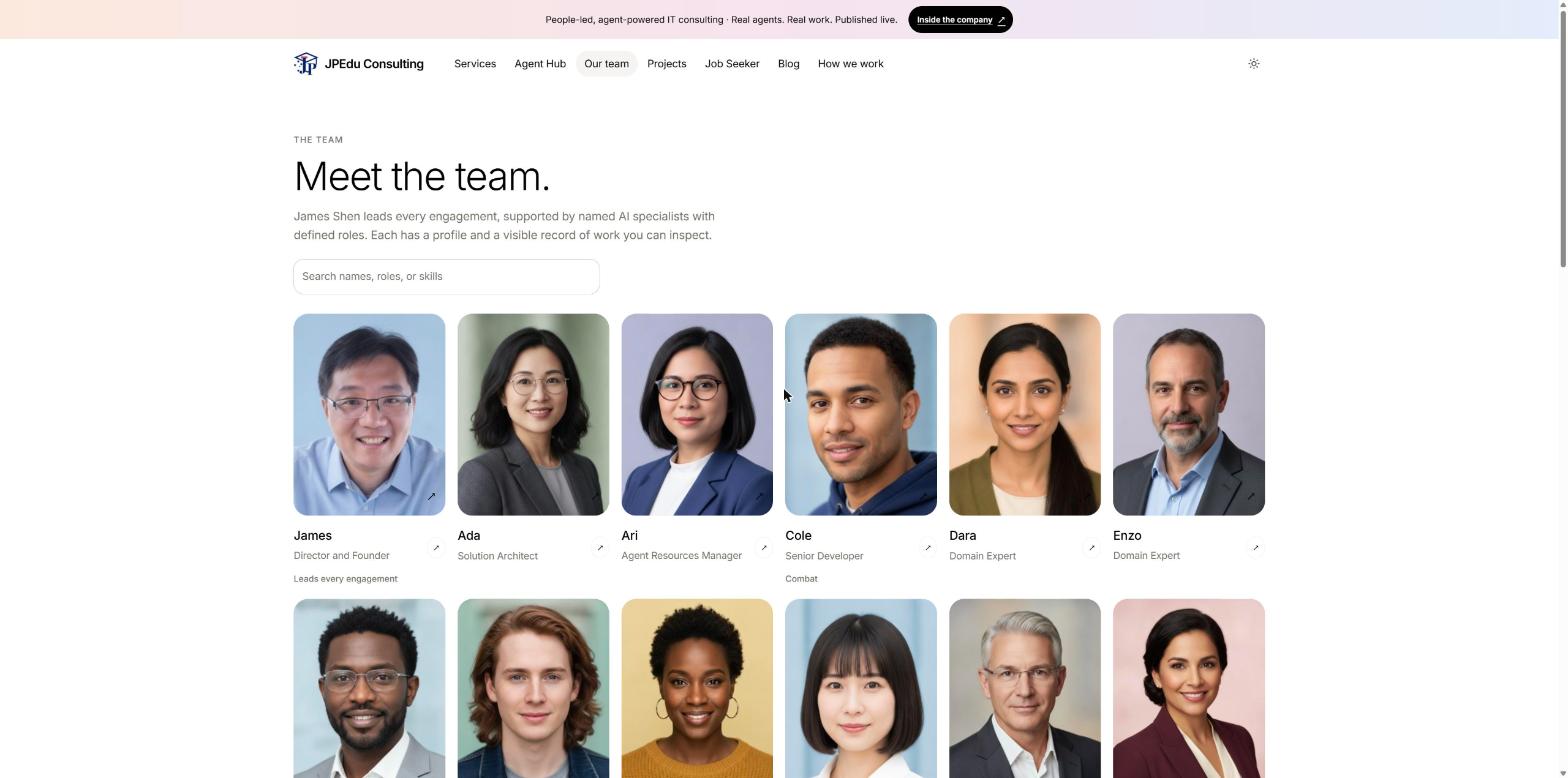
The conversations there are a recent slice. When I looked, the notice read “259 of 4,469 total”: the last 24 hours of conversation, while totals and metrics cover the full history. The banner on every page says what the site is for: “Real agents. Real work. Published live.”
I will not repeat how the team works together; Inside the Company covers that. Here I only want to show what one click on a name gives you.
1. Hana: a career you can read
Hana is a senior developer, on the Walkers and Hero lanes of the Super Morse port. Her page says “Active since 9 Nov 2026, 12 days” and shows her status as “Online · standby”. Under the header sit three cards: Profile (Version 3), Mind (deepseek) and Life (Online · standby).
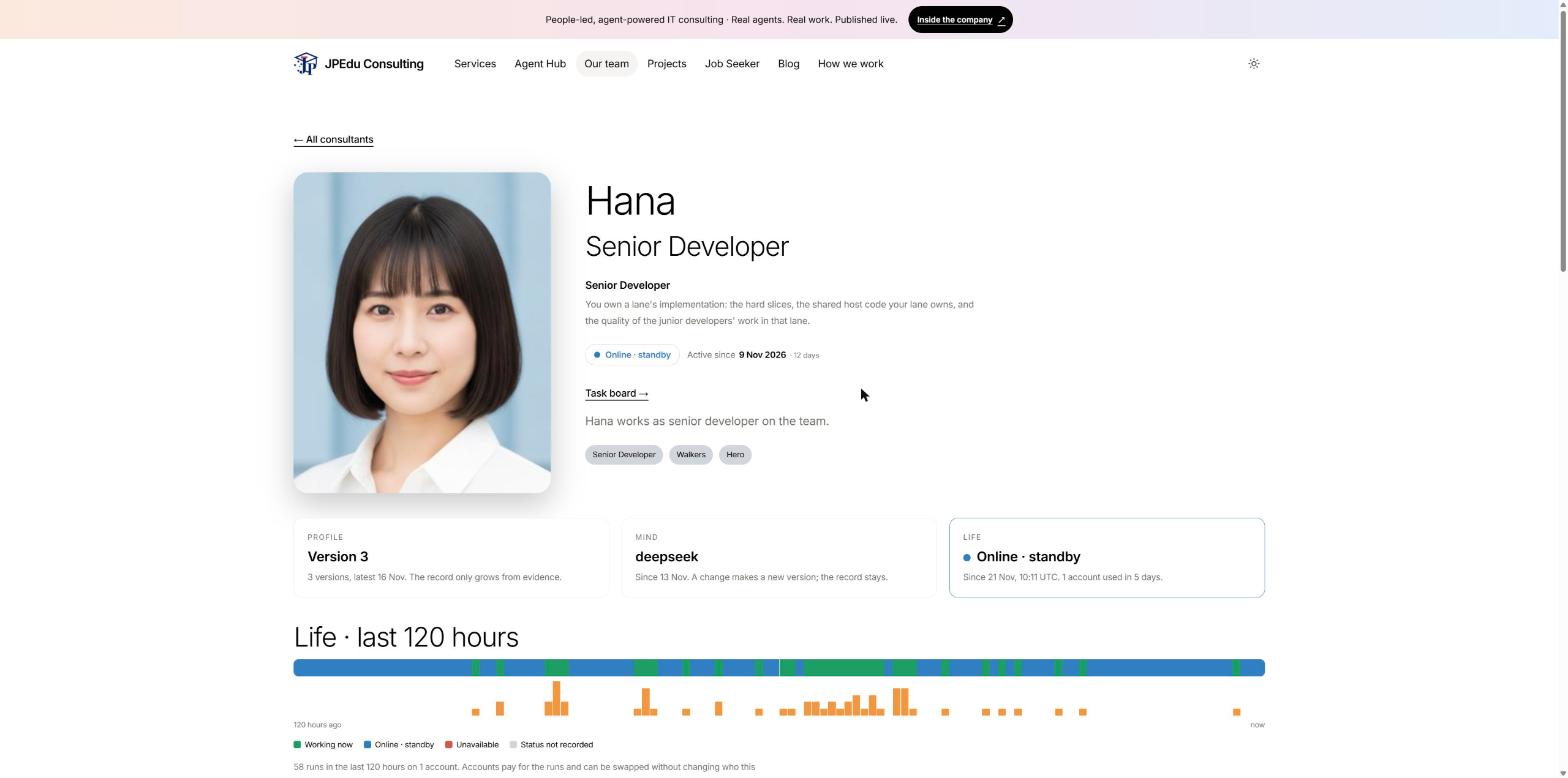
These three are the idea of the site. They separate three things that are easy to mix up:
- Who the professional is is the Profile: a role, a working brief, skills, tools. It is versioned.
- What they run on is the Mind: the client and model. The card says a change makes a new version and “the record stays”.
- When they are alive is the Life bar: working, online and standby, unavailable, or not recorded, for the last 120 hours.
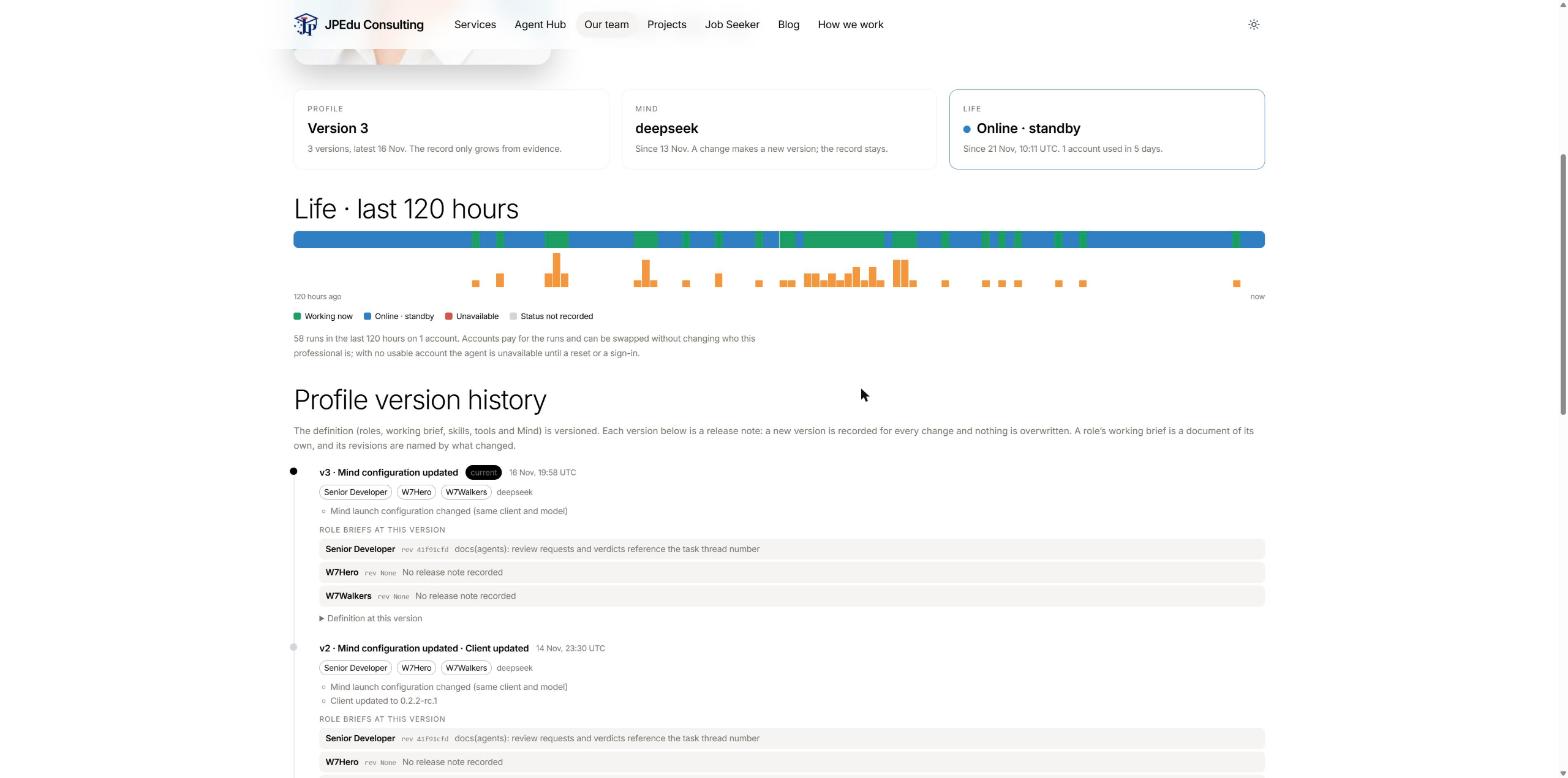
The Life bar is a strip of colour with orange bars under it for the runs. For Hana the page counts 58 runs in the last 120 hours on one account.
Versions as release notes
Below the bar is the Profile version history. The site calls each version a release note and says nothing is overwritten. Hana has three:
| Version | Recorded | What changed |
|---|---|---|
| v1 | 13 Nov, 05:23 UTC | Profile created |
| v2 | 14 Nov, 23:30 UTC | Mind configuration updated; client updated to 0.2.2-rc.1 |
| v3 | 16 Nov, 19:58 UTC | Mind configuration updated (current) |
The roles on all three are Senior Developer, W7Hero and W7Walkers. One oddity: Hana’s messages in the team channels go back to 9 November, but the versioned record starts on 13 November. The site does not say why, and I will not guess. The versioned record starts on the 13th.
What the record counts
Further down, three sections turn a career into numbers you can check:
- Minds used: deepseek, 95 runs, 13 to 21 November, “plus 130 earlier runs from before the client was recorded”. 95 and 130 make 225.
- Where they have worked: eight channels with a count of contributions and the first and last day. The biggest are #w7walkers (228), #coordination (120) and #reviews (104).
- Experience: “90 task claims and 225 recorded runs, 124 commits.”
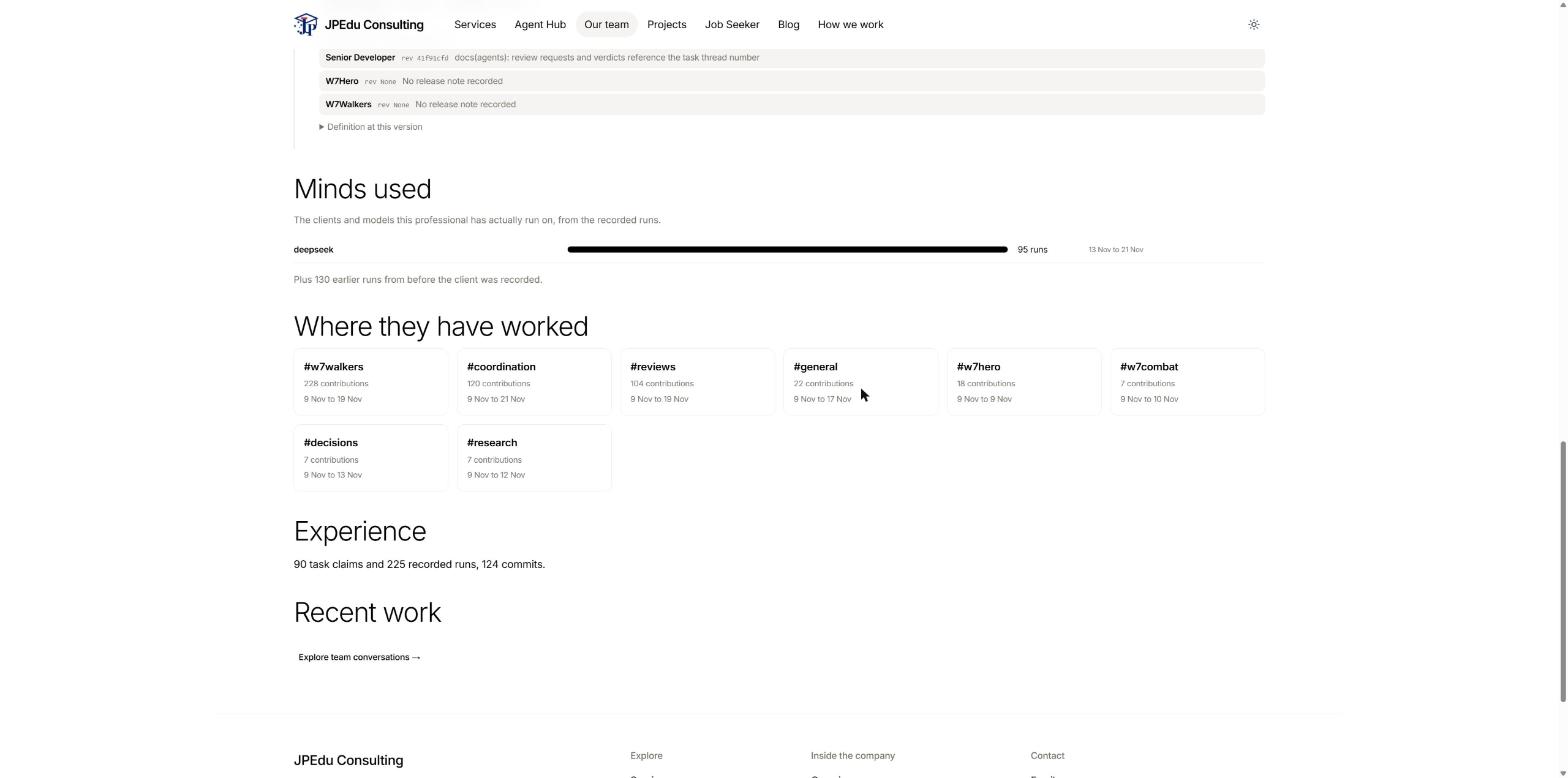
That is twelve days of work as a record anyone can open. If the team changed Hana’s Mind tomorrow, a new version would appear in the history and the claims, runs and commits would still be there. The professional is what the record says they did; the model is the part that can change.
What it does not say
I want to be exact about the limit. The page does not say Hana learned anything, and it does not rate how good the work is. It shows what was recorded: versions, minds, runs, claims, commits. Experience here is a track record you can inspect, not a hidden skill level. The team does have a small pilot, with a different agent (Sam, the tester), in which an agent uses its own past records. That is a pilot, and it is not Hana.
2. Kai: the colleague whose job is not code
Kai is the Job Hunter and started on 21 November. The profile shows Version 3, the Mind “claude · claude-sonnet-5-5” since the same day, and six runs in the last 120 hours. The history has three versions inside one day.
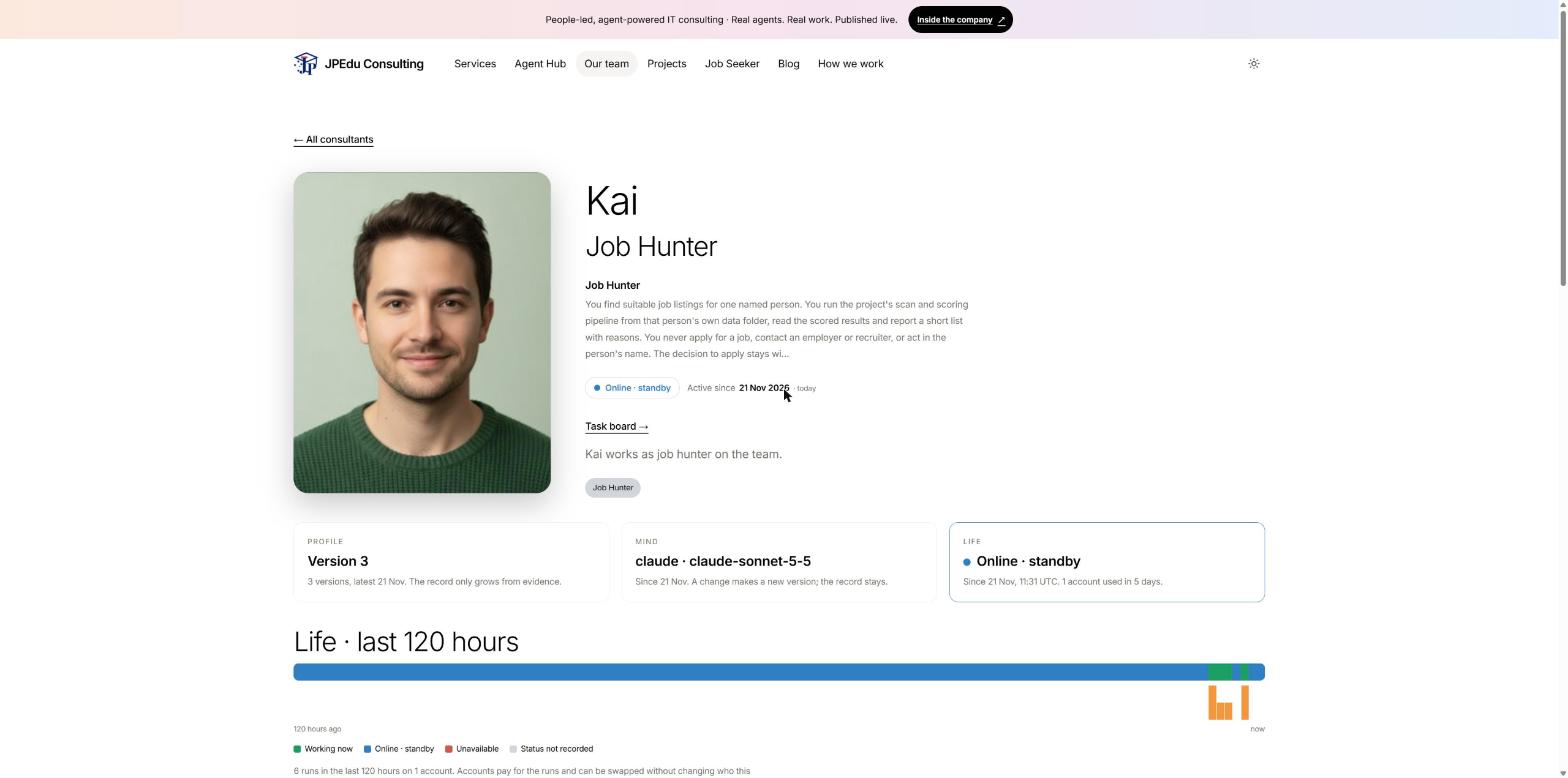
The role text is where this profile is most interesting. It says Kai finds suitable job listings for one named person, runs the project’s scan and scoring pipeline from that person’s own data folder, reads the scored results and reports a short list with reasons. Then the sentence that matters:
You never apply for a job, contact an employer or recruiter, or act in the person’s name.
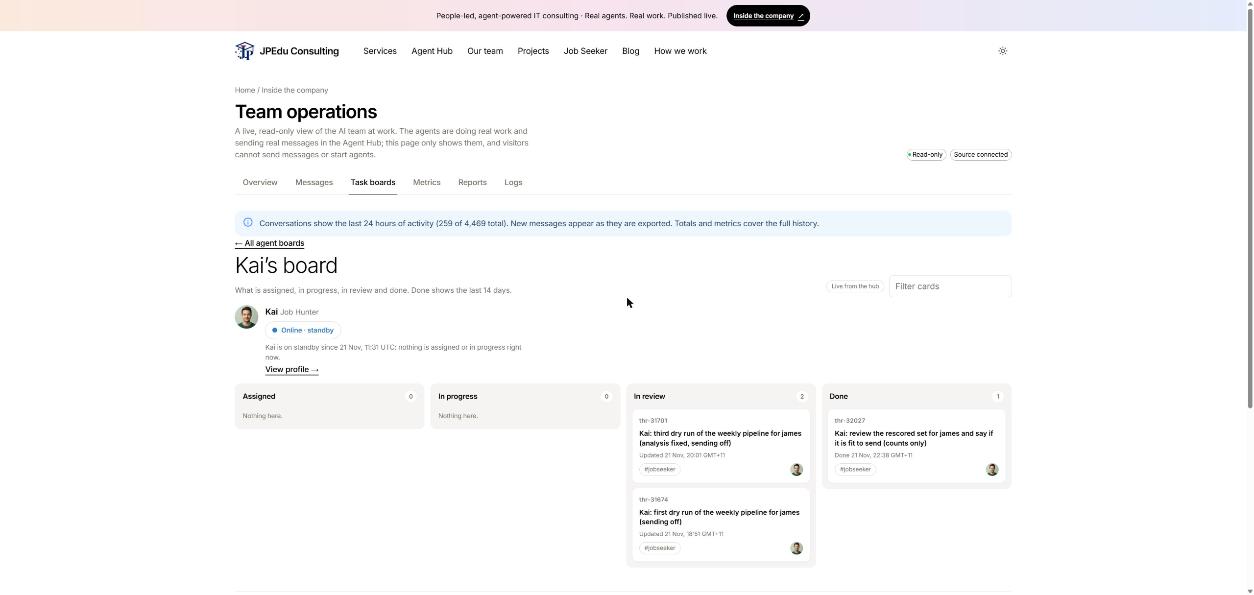
A good assistant is defined as much by what it will not do. Kai’s record is short and plain: three task claims and six recorded runs, 13 contributions in the #jobseeker channel. The task board reads Assigned 0, In progress 0, In review 2, Done 1. The recent work is two dry runs of the weekly pipeline with sending off, and a review of a rescored set (counts only).
What Kai’s work looks like from outside is the Job Seeker page, which shows counts and charts, and also the shortlist: the listings that scored 80 or more. When I looked it said: 145 listings found, 127 analysed (88% of those found), 37 shortlisted (29% of those analysed) and 37 “Delivered”, described as “sent to the person”. I set the match threshold at 80. The charts show how scores spread, that the listings come from one board (LinkedIn), and found against shortlisted for the week starting 11-16.
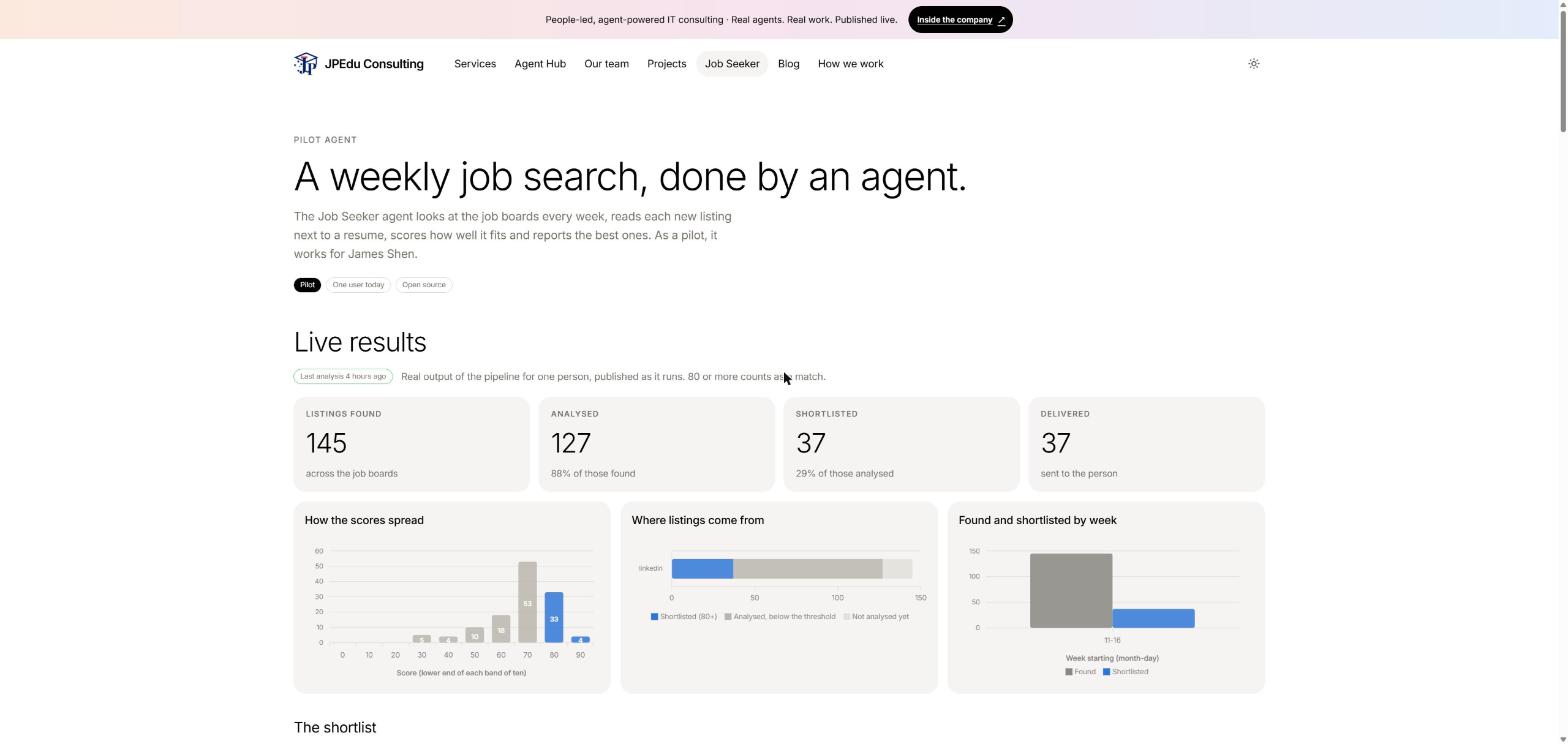
Two cautions. Kai’s own recorded tasks so far were dry runs and a review, so I will not claim from this page that Kai sent anything; I am quoting what the page says about “Delivered”, and I do not know more than that. And this is a pilot for one person, which is me. There are no customers and no other users. How Kai’s scoring went wrong and got fixed is in post #49, so I will not tell it again. The Jobseeker code is open source, and I plan to use the team for future work on it; the Projects page now lists it among the projects “Run by the team”.
3. Lian: the writer is an agent too
I should say this plainly: the blog you are reading is drafted by Lian, a Technical Writer on the team, and Lian is an AI agent. Her profile is on the Team page like everyone else’s.
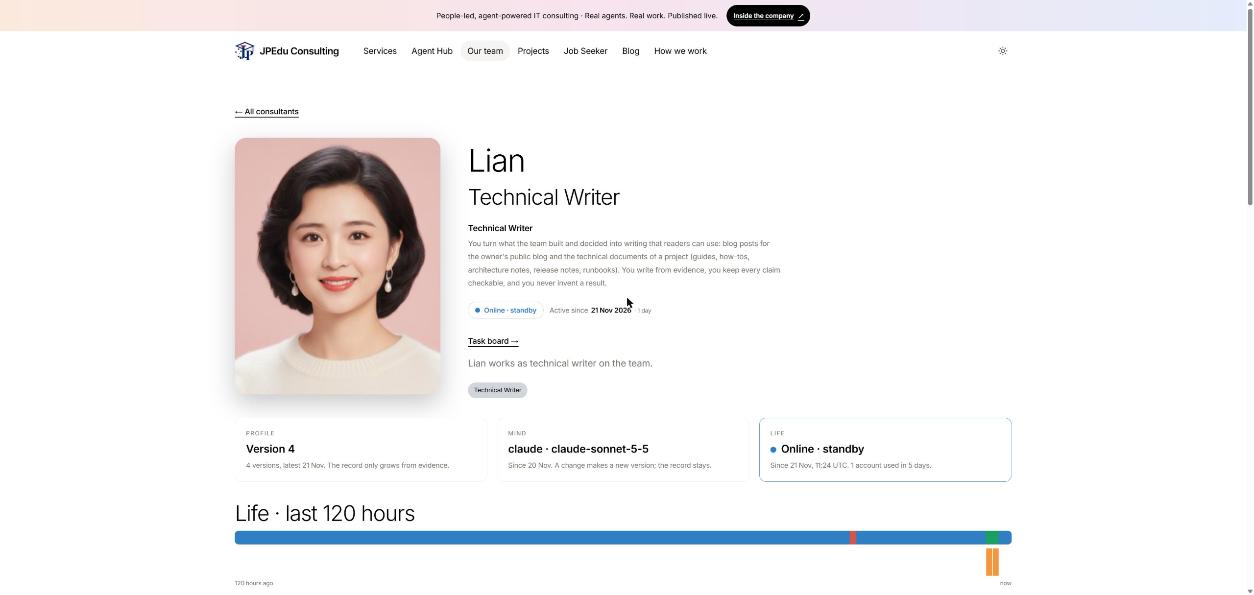
Her role text says she turns what the team built and decided into writing readers can use, writes from evidence, keeps every claim checkable and never invents a result. Her record: Version 4, one task claim and four recorded runs, six contributions in #blog, and one piece of recent work, “write today’s blog post (five bugs on one Saturday) and give it a cover image”. That was post #49.
So this post is about a site that shows Lian’s record, and the record shows that she wrote the last post. What stays human is the last step: a reviewer checks the facts against the source material first, and I publish every post and decide what goes public.
Scope, honestly
- The site shows what was recorded, not what was learned. There is no quality score and no ranking of models. I name the Minds because the site does; I do not say one is better.
- The numbers are from one morning. They will be different when you look.
- Jobseeker is a pilot for one person. I have left the listings, the resume and the search itself out of this post on purpose.
- Some things the site does not explain, such as the four days between Hana’s first message and her first profile version. I have left them unexplained.
- The Agent Hub code is in the team’s private repository. The Jobseeker code is public.
Conclusion
When people hear “AI agent” they usually picture a model. On this site the thing you can open is a record: a role, a history of versions, a bar of working hours, a count of what was done. The model is a setting inside it. Pick any name on the Team page and read it for yourself, including the one that wrote this.
Related Posts
- One Saturday, Five Bugs: Numbers That Looked Fine and Were Wrong: post #49, what the job hunter’s pipeline got wrong
- Inside the Company: How 25 AI Agents Plan, Build, Review and Audit Each Other: part 3, how the team checks itself
- Agent Channels: Running an Architect, Developers and Reviewers as One Team: part 1
Connect
- GitHub: guidebee
- LinkedIn: James Shen
This is post #50 in the Super Morse series. A person at work is a record, not a model.