
Giving NPCs a Brain: Enemy Design and Reverse-Engineered Actor Rules
Published:
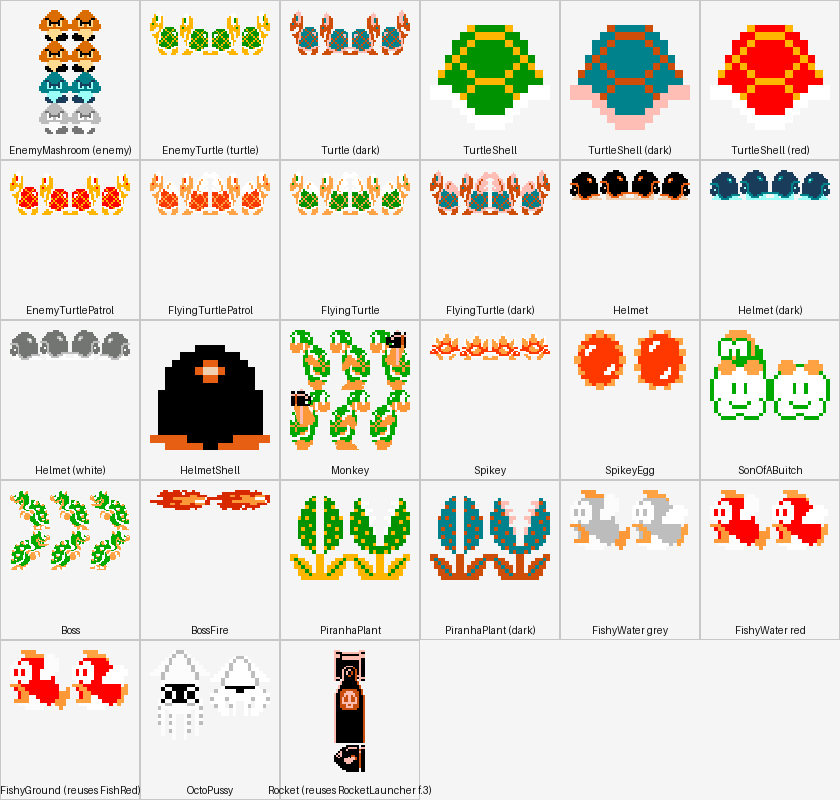
Post #40, the last in the Super Morse series. Everything so far — architecture, physics, levels — sets the stage for the part of a platformer players actually spend most of their attention on: what the things trying to kill you actually do. One game’s enemy roster I designed myself, with a consistent rule I could just write down. The other game’s 316-resource actor registry had no such rule available to write down — it had to be decoded from an obfuscated rule VM, one numbered action type at a time.
TL;DR
- Mario’s enemy field guide follows one consistent rule — stomp from above to defeat, touch from the side and it hurts you — with a handful of deliberate, clearly-labeled exceptions (
Spikeynever dies to a stomp;Helmetshrugs off fireballs). - The reverse-engineered game’s 316 actor resources had no such rule available up front — each one’s behavior lives in a numbered, per-resource rule program that had to be decoded and translated into a plain-English contract, graded by confidence the whole way.
- The single biggest unlock was building a shared rule vocabulary — one table mapping “action type 25” to “spawn a pooled clone, place it, set it active” — so that decoding resource #202 didn’t mean starting from zero after decoding resource #97.
- Worked example: a push-button-and-bridge mechanism (resources 97/104/105) went from “three numbers in a registry” to a fully specified contract — including a subtlety the original handbuilt port had gotten wrong — once its rules were actually read rather than guessed at.
Mario: One Rule, Named Exceptions
The enemy roster’s whole design fits in one sentence, and the field guide states it exactly that plainly: jump on top of most enemies to defeat them; touching them from the side hurts you — unless you have a Star, in which case any touch destroys them.
| Enemy | Stompable? | Notes |
|---|---|---|
EnemyMushroom | Yes | The most common enemy by far; walks forward, turns at walls, falls into pits |
EnemyTurtle | Yes, leaves a shell | Kick the shell to send it sliding — it defeats other enemies, but also hurts you |
Helmet / HelmetShell | Yes, fireball-immune | Same shell-kick trick works; Fire Mario’s fireballs bounce off |
Spikey / SpikeyEgg | No — never | Every touch hurts, from any side, unless starred |
Boss | Only with a Star | A stomp or side-touch just hurts you; six fireballs or one Star kill it |
Every exception in that table is a deliberate genre convention I chose, not an accident of implementation, and it’s stated as such: Enemy’s contract (onStomped/onTouchedSide/onDefeatedByProjectile/bouncesOffEnemies) is a genuinely game-agnostic three-verb reaction interface — only the default implementations encode Mario’s specific rules, and even those defaults are “reasonable platformer-genre defaults,” explicitly flagged as the kind of thing a hypothetical second game could override without touching the interface itself. That’s the same architectural boundary from the architecture post in this series, just seen from the enemy side instead of the player side.
The Reverse-Engineered Game: No Rulebook, Just a Rule VM
The other game’s 316 actor resources have no field guide to start from — their behavior lives in a per-resource, per-instance rule program (levels/<id>/collision.mo123.bin, despite the misleading path — it’s an actor behavior program, not level collision data), executed by a shared runtime class evaluating ordered if/else-if/jump rules over the actor’s own state arrays.
The single move that made this tractable instead of a 316-times-repeated slog was building one shared vocabulary table, once, mapping numeric action/condition types to plain meanings — with every entry graded by evidence tier:
| Action type | Meaning | Tier |
|---|---|---|
| 0 | Move the actor by its speed field, direction 0-3 | field layout recovered |
| 23 | startAscent(v) — begin or adjust a jump/gravity impulse | recovered |
| 25 | Spawn: take a pooled clone, place it, activate it, optionally bind it to a target’s touch-list | recovered |
| 45 | Bind query: refresh “who is touching my rectangle right now,” up to n actors, by several selection modes | recovered from a three-game DEX cross-reference |
| 56 | Grid stamp: write a material value into the level’s collision layer — 1 solid, 2 one-way, 5 low-friction, 66 water, 99 lethal | recovered |
| 6, 7, 9, 15… | Spawn/attack configuration, particle effects, rare setters | still undecoded, printed raw rather than guessed |
That last row matters as much as the recovered ones — the vocabulary table is honest about what it doesn’t know yet, and a rule that hits an undecoded action type gets printed raw rather than silently treated as a no-op. An unsupported term staying visibly unsupported is the whole point; the alternative is a behavior that looks implemented and just quietly does nothing.
Worked Example: A Button, a Bridge, and a Bug the Port Already Had
The most satisfying single result from this decoding effort was a mundane-sounding push-button mechanism — three actor resources (97 the button, 104/105 the two states of a bridge block it controls) — because decoding it found and fixed a real behavioral gap in logic I’d already hand-built:
- Resource 97 refreshes a “who’s touching me” list every tick from its own rectangle. While that list is non-empty it sets an internal flag; a rising edge plays a “pressed” animation with a sound, a falling edge plays “released” the same way.
- Resources 104 and 105 each mirror that same flag from 97 via a direct actor-to-actor compare — one is solid at rest, the other is its exact inverse, and each rising edge flips which one is solid, pushing anything standing on the newly-solid block 80 units aside.
The correction that fell out of actually reading rule 0 rather than assuming: the press condition is “any untagged active actor touching the plate’s rectangle,” not “the hero standing on it while grounded.” My own hand-built SwitchNetwork implementation had assumed the latter — a completely reasonable design guess, and close enough that nobody had noticed it was wrong — right up until the recovered rule showed it also fires for an actor touching the plate mid-air, or for something other than the hero entirely. That’s a small gap, but it’s exactly the kind of thing that would have shipped quietly wrong forever without ever going back to the source and checking.
The Boss Fight That Needed a Whole Cross-Reference Table
Not every actor decoded this cleanly. Kuba, one of the game’s bosses, needed its own dedicated research pass — separating a decorative “story” version of the boss from the one whose health (system variable S[30]) actually drives a real fight, resolving that its on-screen health bar loses exactly 10 per qualifying hit, and pinning down that its defeat trigger reads a different per-frame attack-target field than its normal hurtbox does. None of that was guessable from playing the original game — the story boss and the real boss look identical on screen — it only became legible by reading the rule numbers directly and cross-checking them against which of the game’s 24 scenes actually place the “real” resource versus the decorative one.
The Same Discipline, Applied to a Harder Target
Everything in this post is really the evidence-tier discipline from the overview post — recovered, inferred, undecoded — pointed at the hardest target in the whole project: 316 resources, most of them reused across hundreds of scene placements, each capable of hiding a subtlety like the button’s mid-air press or Kuba’s split identity. What made an AI assistant genuinely useful here wasn’t writing enemy code — Mario’s enemy roster didn’t need any archaeology, and got built the normal way. It was the willingness to grind through a numbered rule table, resource by resource, without quietly rounding an unresolved condition type into a plausible guess just to keep the narrative moving. That’s tedious in a way that’s easy to shortcut and hard to catch after the fact — which is exactly why grading every claim by its evidence tier, out loud, in the docs themselves, turned out to be the load-bearing habit for this whole side of the project.
Related Posts
- Building a Mario-Like Platformer — and Resurrecting Three Lost Android Games — the series overview
- Tuning the Jump Arc: Platformer Physics, Recovered and Designed — the same recovered-rules discipline, applied to the player instead of enemies
- Level Design at Scale: Atlases, Tile Catalogs, and 356 Decompiled Scenes — where these actors actually get placed
Connect
- GitHub: guidebee
- LinkedIn: James Shen
This is post #40, closing out the Super Morse series — five posts on building an AI-assisted platformer and reverse-engineering three abandoned Android games alongside it.